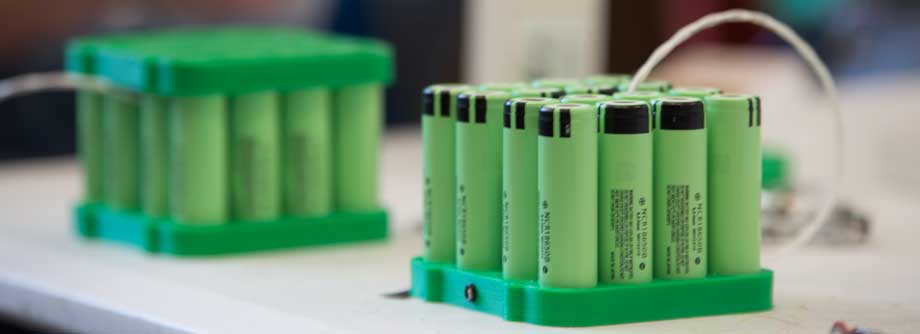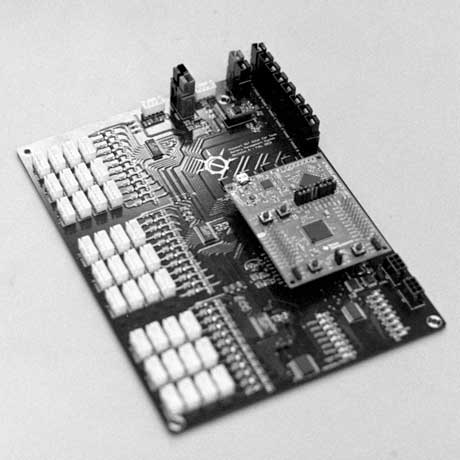
While I was the electrical lead for the Missouri S&T Solar Car Team, I had the opportunity to lead the design of a new multi-cell battery monitoring and management system for lithium-ion batteries.
Throughout development of this system, I was the primary electrical designer as well as the primary software architect. When we began, we set out a simple set of requirements:
- CAN bus for vehicle telemetry
- Total pack current sensing
- Full pack voltage measuring
- Open drain outputs for controlling fans and contactors
- Temperature and voltage measurement of up to 36 series lithium ion battery modules
- Debug and status indicators
The system was planned to be controlled by a TI MSP430-based processor, due to its extremely low power consumption, excellent development ecosystem, and onboard peripherals. To allow easy debugging and programming, an MSP430 Launchpad development board header is used to allow swapping out the onboard microcontroller easily and quickly.
Measurement of the battery stack quickly became a challenge. We had to investigate the use of differential analog-to-digital conversion in order to deal with the high common mode voltages of nearly 110V across the pack. In the end we settled upon a 12-cell differential battery stack monitoring IC from Linear Technologies that worked incredibly well.
Temperature sensing at 26 different nodes in the pack also became a challenge quickly, as using standard thermistors or other resistive thermal devices leads to a large number of analog-to-digital conversions required. I chose and developed drivers for our application stack to interface with one-wire serial temperature sensors from Dallas, which provided a one-wire bus topology allowing easy digital measurement of all the cells in the stack.
I led the design and requirements phase, and did all of the schematic design in Eagle CAD. Myself and one of my teammates did the hardware design together. When we progressed to the software development phase, I wrote the entire application stack from the ground up. It is not quite an RTOS, but it implements basic task queuing and process management.
The BMS completed its first race in the 2016 American Solar Challenge, helping the team win the Electrical Design Award amongst the 21 teams present.